Posts mit dem Label Sharp Practice werden angezeigt. Alle Posts anzeigen

Samstag, 25. März 2023

my personal dice tower

There are the classics among games that do without random mechanisms, such as Go or chess, but also many board games such as the 18xx series, Diplomacy or the wonderful Civilization, to name just a few. In very many games, a more or less large random or luck mechanism is an inherent part of the game. This may be the distribution of cards or positions at the beginning of the game, the random drawing from a pile or a bag, or the spinning of a spinner, etc.

In my opinion the most popular random mechanism in (war)games is the throwing of dice. It is so widespread that there are numerous tools for it to help us ensure that

- our dice do not roll under the sofa

- the pawns and meeples stay in place and are not knocked over by the dice

- and last but not least ... they prevent intentional or unintentional manipulation of the die roll.

These tools are the dice cup, the dice tray and of course the dice tower. In this blog post, I want to tell you about a small but very practical dice tower that is cheap to buy, easy to assemble and - most importantly - can be personalised very nicely. It is the foldable dice tower by Too Fat Lardies:


This dice tower is suitable for up to about a dozen 16mm D6 dice. When not in use, it can be folded into a small box of 12x8x5cm. As you can see in the picture, there ist the Too Fat Lardies logo edged in on the front of the tower and of the dice tray. 

The TFL Dice Tower is a small and practical tool in its original state. In addition, however, it can also be personalised very easily. 


When assembling the dice tower, you can simply place the front plate of the tower and the front plate of the dice tray with the logo facing inwards. This way you get a neutral dice tower and a free area that you can design yourself. 

See how I designed my own dice tower: On the front I placed a variant of the coat of arms of my hometown by adding a medieval halberdier:


On the back I have painted a 16th century banner bearer of the Canton of Solothurn, based on a painting by M. Jacobson from the book "die Banner der Heimat",1942:


For a friend I painted the dice tower with a modified coat of arms of the canton of Bern:


Maybe with this post I can inspire you to create your own dice tower. I look forward to your comments.


Mittwoch, 12. Dezember 2018

The capture and subsequent rescue of mademoiselle Mireille Masséna - a Sharp Practice AAR

In early 1811 the french "army of Portugal" lead by Marshal André Masséna, withdraws from Portugal famished and exhausted. Masséna did not succeed to decisively beat the british-portuguese forces. The letters he writes to his wife and brothers in France are filled with bitterness about the abysmal political and military situation in Spain and Portugal.

André Masséna, Marshal of France

Sonntag, 21. Oktober 2018

Die Gefangennahme und Befreiung der Mireille Masséna 1811 - ein Sharp Practice Spielbericht

Im Frühjahr 1811 muss sich die französische "Armée du Portugal" unter der Führung von Marschall André Masséna erschöpft und ausgehungert aus Portugal zurückziehen. Masséna ist es nicht gelungen, die britisch-portugiesische Armee entscheidend zu schlagen. Die Briefe an seine Frau und seine Brüder sind voller Bitterkeit über die miserable politische und militärische Lage in Spanien und Portugal. 
André Masséna, Marschall von Frankreich

Freitag, 31. August 2018

The first days of March 1798 - A Sharp Practice After Action Report

In early spring of 1798 the french "armée d'Helvétie" under the command of general Brune is ready to bring the Swiss Cantons to heel, first of all the city state of Berne. While there are still negotiations going on the diplomatic level, the french army is steadily reinforcing their positions.
In the morning of the 1st of March First Lieutenant Etienne Moulin-Rouge gets the order to capture and occupy the farm of Adalbert Bonstetten, a wealthy bernese farmer. There are two objectives related to this action: First the farm shall be cleared of all bernese troops and then the farm shall provide provisions for the french army.


the farm of Adalbert Bonstetten


Sonntag, 19. August 2018

Märztage 1798 - ein Sharp Practice Spielbericht

In den ersten Tagen des März 1798 steht die französische "Armée d'Helvétie" unter Genéral Brune bereit, die Eidgenossenschaft und insbesondere den Stadtstaat Bern unter ihre Kontrolle zu bringen. Während auf diplomatischer Ebene verhandelt wird, verstärkt die franzöische Armee ihre Positionen stetig:
Der 1er Lieutenant Etienne Moulin-Rouge erhält am Morgen des 1. März den Auftrag, den Hof des reichen bernischen Bauern Adalbert Bonstetten einzunehmen und zu besetzen. Die Franzosen verfolgen damit zwei Ziele: Einmal sind auf und um den Hof bernische Truppen stationiert - diese sollen vertrieben werden; zum anderen könnte die französische Armee die reichen Vorräte, die man auf dem Hof vermutet, gut gebrauchen.

der Hof von Adalbert Bonstetten

Sonntag, 12. November 2017

Bernese Farmhouse of 1789 for Sharp Practice Games

The landscape of northwestern Switzerland at the end of the 18th century
The invasion of the City-State of Berne's territory by the French in early 1798 happened on two different routes: One corps of the "Armée d'Hélvetie" started in the region north of the lake of Geneva called "Vaud" moving north through the town of Fribourg and crossing the river Sense at Neuenegg. Second corps started in the territory of the Bishopric of Basel, moving south through the towns of Biel and then Solothurn, where it crossed the Aare river and then moving south toward Berne (see map). At this time both routes were leading through scarcely built-up or cultivated regions. Large parts of the landscape were wooded or swampy areas.

 
the region between the towns of Biel (french: Bienne) and Solothurn (french: Soleure) in 1780 (https://commons.wikimedia.org/wiki/File:UBBasel_Map_1780_Kartenslg_Schw_B_55_evech%C3%A9_de_Bale.tiff)


Samstag, 11. November 2017

Berner Bauernhaus für Sharp Practice 1798

Das Gesicht des schweizer Mittellands Ende des 18. Jahrhunderts

Die Invasion des bernischen Gebiets durch die Franzosen im Frühjahr 1798 führte auf zwei Wegen nach Bern. Einmal aus der schon besetzten Waadt über Fribourg und Neuenegg, und vom ebenfalls besetzten Jura her kommend über Biel, Solothurn, Fraubrunnen und Grauholz. Beide Wege führten damals durch kaum bebautes Gebiet, welches nur zum Teil landwirtschaftlich genutzt wurde. Ein grosser Teil der Landschaft war bewaldet oder sumpfig.

die Gegend zwischen Biel und Solothurn um 1780 (https://commons.wikimedia.org/wiki/File:UBBasel_Map_1780_Kartenslg_Schw_B_55_evech%C3%A9_de_Bale.tiff)

Sonntag, 12. Februar 2017

Ein Bilderrätsel für Wargamer

Was ist auf dem folgenden Bild zu sehen?
a) eine Tischdecke
b) ein Innenschlafsack
c) ein Barchent-Leintuch


Natürlich hat die gewiefte Historikerin ebenso wie der interessierte Laie sofort entdeckt, dass keine der drei angebotenen Lösungen richtig ist. Es handelt sich nämlich um das zusammengefaltete Grabtuch von Turin:


... welches schon seit langer Zeit im Dom von Torino aufbewahrt wird und darum NICHT zusmmengefaltet auf meinem Wohnzimmertisch liegt. Bei dem textilen Ding auf dem Foto oben  - und jetzt kommt des Rätsels Lösung - handelt es sich um


eine Battle Mat der Firma Cigar Box. Die Firma bietet textile Spielmatten in diversen Designs und Abmessungen an. Für meine Sharp Practice Spiele habe ich mir die Grassland Battle Mat bestellt. Sie ist aus einem dünnen, fleece-artigen Material, einseitig bedruckt und die Seitenkanten sind sauber vernäht. Auf dem Tisch ausgebreitet sieht sie so aus:

 
Das Material hat eine ganz feine Struktur und eignet sich aus meiner Sicht für das Spiel mit 15mm Figuren ebenso wie mit 28mm Figuren:

15mm DBA Figuren mit Lager

28mm Figuren und Gebäude

Beim Bewegen der DBA-Basen auf der Matte ist je nach Bewegungsrichtung ein ganz leichter Widerstand zu spüren, in einer anderen Richtung gleiten die Basen perfekt - offenbar spielt die Webstruktur der Matte eine Rolle. Das exakte Positionieren der Basen - wie es für DBA-Spiele so wichtig ist - funktioniert aber problemlos.
Bei meinem kurzen Test habe ich die Matte auf die drei rohen Sperrholzplatten gelegt, die ich bis jetzt schon als Unterlage für die Modelleisenbahn-Grasmatte verwendet habe, die mir bisher als Spielfeld gedient hat. Auf dieser Sperrholzunterlage haftet die Cigar Box Battle Mat perfekt und verrutscht nicht. Ob dies auch auf einer glatten Tischoberfläche so ist, wird sich herausstellen. Evtl. muss die Matte auf einem glatten Tisch zusätzlich fixiert werden?

Die Matte soll laut Hersteller die Dimension 4 x 6 ft PLUS, genauer 56 x 76 inches (142 x 193 cm), haben. Meine Matte misst exakt 155 x 200 cm - sie ist also sogar etwas grösser als angegeben. Die 155 cm Breite sind super, weil man so darauf DBA Big Battle spielen kann, wofür das Spielfeld 2 x 75 cm breit sein muss.

Optisch gefällt mir die Matte sehr gut. Sie ist relativ dunkel, was dem mitteleuropäischen Grasland gut entspricht. Die Matte lässt sich einfach wie ein Grabtuch ehh, Tischtuch zusammenlegen und ist darum einfach transportierbar und benötigt wenig Platz zum Aufbewahren.

Die Matte wird Mitte März getestet, wenn darauf am Vormittag Sharp Practice und am Nachmittag ein DBA Big Battle der Schlacht von Marignano gespielt wird.


Donnerstag, 26. Januar 2017

Artillery Movement Tray for Sharp Practice 2

When I started playing Sharp Practice I used individually based miniatures. This looks nice and is very convenient for removing casualties. Meanwhile moving groups of eight or ten men or even formations containing up to twenty single minis or more on the battlefield takes some time. With Sharp Practice 2 emphasizing moving and fighting in various formations, the use of movement trays simplifies the handling of your groups and formations in play and we can find a number of manufacturers of movement trays of all forms and sizes on the web.

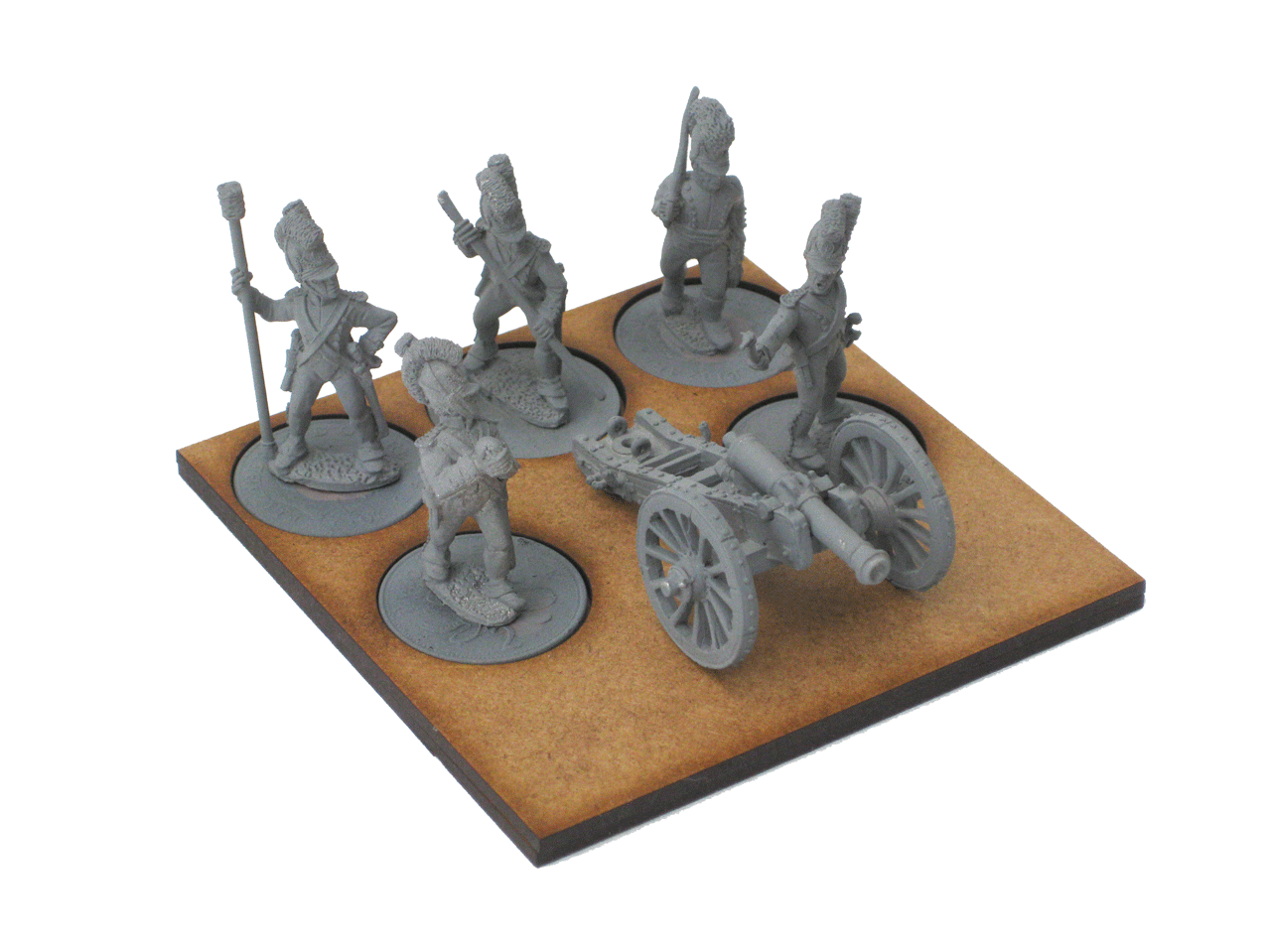
Recently I came across the webshop of Charlie Foxtrot Models. They too offer a range of rectangular and irregular shaped movement trays for our line infantry and skirmisher groups in Sharp Practice 2. What I had not seen before elsewhere was a movement tray designed for artillery groups. This artillery movement trays can hold five miniatures - the standard number of men serving one piece in SP2 - and they come in two different configurations:


 I ordered two of the upper variant which I like more and this is what I got:


So I glued the slotted part on the base part with standard PVA glue, then drilled holes in the base to hold circular magnets which I fixed with superglue. Then I added a layer of  filler material to have a natural looking surface:


Then I painted the base and added some tufts and grass mixture - ready


The whole procedure took little time and the base turned out nice and handy:

This is an artillery group of my 1798 Bernese Army with a 6pdr piece on the newly  finished movement base with an artillery officer off the base. I must point out that this artillery movement tray is designed to hold minis based on UK 2p coins which have a diameter of 25.9mm. Since I am basing my minis on 24mm washers the slots are slightly too large but the resulting gap does not bother me at all.

Samstag, 31. Dezember 2016

Sharp Practice Deployment Point Competition

Fast hätte ich es vergessen .. ich habe nämlich einen Preis gewonnen!

Vor einigen Monaten wurde das neue Regelwerk Sharp Practice 2 veröffentlicht. An Stelle der bisherigen "Blinds" für verdeckte Bewegungen werden nun so genannte  "Deployment Points" verwendet. Ein Deployment Point markiert eine Stelle auf dem Spielfeld, von wo aus die eigenen Truppen sicher ins Spiel gebracht werden können. Je nach Gelände und Truppentyp kann eine Einheit nahe oder weiter entfernt von diesem Deployment Point aufgestellt werden. Mein Gegner hat also eine ungefähre Ahnung, wo meine Truppen auf dem Spielfeld erscheinen werden, aber nicht mehr.

Diese Deployment Points können mit simplen Papierstücken, Münzen, etc. auf dem Spielfeld markiert werden. Man kann diese Marker auch so gestalten, dass sie sich optisch und thematisch ins Spielfeld eingliedern: Zwei rastende Soldaten oder ein Karren mit Proviant, usw. könnten zum Beispiel als Deployment Point dienen und gleichzeitig das Spielfeld optisch bereichern.

Beispiele für Deployment Points für Sharp Practice 2


Der Autor von Sharp Practice hat zu diesem Thema einen Wettbewerb ausgeschrieben. Man musste für eine Armee zwei Deployment Points gestalten. Grösse, Massstab der Figuren und historischer Hintergrund waren in Grenzen frei wählbar. So habe ich für die französische Armée d'Helvétie und die Berner Armee von 1798 je zwei Deployment Points gestaltet und zum Wettbewerb angemeldet.

Für die Franzosen habe ich eine Szene mit einem Freiheitsbaum, wie er damals von den Befürwortern der französischen Revolution als Symbol verwendet wurde, und eine Szene mit einer Cantinière und einem durstigen Soldaten gestaltet:


Für die Berner Armee von 1798 habe ich eine Szene vor einem Wachhäuschen und einen Bären, der seine Höhle verteidigt, gewählt:


Nach langen Beratungen hat die Wettbewerbs-Jury die Gewinner des Wettbwerbs bekannt gegeben. Zu meiner grossen Freude (und Stolz) haben meine beiden französischen Deployment Points den 1. Platz erreicht!! 😊😊😊


Sonntag, 25. Dezember 2016

Berner Grenadiere 1798

Berner Grenadiere Ende 18. Jh.

Eine kleine Einheit Berner Grenadiere ist fertig bemalt und basiert. Sie ergänzen mein bereits fertig gestelltes Musketier-Batallion "Oberland":

Musketier-Battallion Oberland mit Scharfschützen-Kompagne

Die Infanterie-Figuren sind aus der 28mm Reihe "1799 Russians" von Eureka Miniatures. Ihre Ausrüstung und Uniformteile entsprechen recht gut den Berner Uniformen des späten 18. Jahrhunderts, wie sie bei Petitmermet, Berner Uniformen 1700 - 1850 beschrieben sind:


Ein paar kleine Modifikationen an den Eureka-Figuren waren aber schon notwendig. So musste ich die Epauletten und Federbüsche der Offiziere ergänzen. Die russischen Grenadiere tragen im Original Spitzhauben, die Berner aber Bärenfellmützen, siehe den Grenadier-Offizier unten links.


So habe ich den Russen ihre Spitzhüte abgesägt und mit Plastik-Bärenfellmützen von französischen Grenadieren von Victrix ersetzt:


Die Kernelemente einer bernischen Truppe für Sharp Practice 2 (SP2) sind damit fertig gestellt. Zur Zeit arbeite ich an etwas Zugemüse für das Spielfeld:
  • Zwei Ärzte, welche in SP2 im Kampf verletzte Anführer heilen können
  • Ziegen als Verpflegung für die Truppe oder einfach als hübsches Element auf dem Spielfeld
  • Scheune
  • Berner Battallionsjäger als leichte Infanterie


Französische 8. Husaren 1798

Das 8. Husarenregiment war Teil des französischen Armeekorps, das im Frühjahr 1798 von Biel über Solothurn nach Bern marschierte und die Stadt besetzte:

Uniform der 8. Husaren 1804 nach https://fr.wikipedia.org/wiki/Jacob_Fran%C3%A7ois_Marola

Für Sharp Practice 2 habe ich eine kleine Einheit der 8. Husaren fertig bemalt und basiert:


Als Kopfbedeckung trugen die 8. Husaren 1798 eine Art Shakos. Die Figuren stammen aus der French Napoleonic Hussar Box von Perry Miniatures.


Die Husaren ergänzen meine bestehende Französische Sharp Practice "Armée d'Helvétie" von 1798:

14. demi brigade légère (links) und 89. demi brigade de ligne (rechts)